New Boston Historical Society
New Boston, New Hampshire
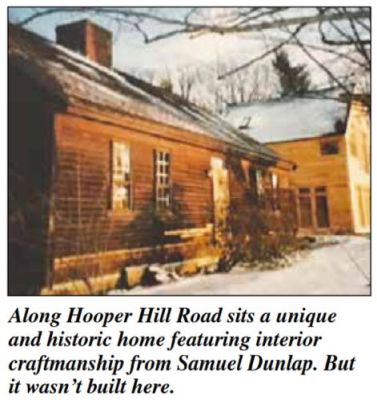
The Dunlap House: 114 Hooper Hill Road
by Mary Atai (September 2018)
The Dunlaps were a family of cabinet makers, living and working in Goffstown, Henniker, Bedford, Salisbury, and other southern New Hampshire towns in the late 1700s and early 1800s. Archibald Dunlap, a weaver and farmer, emigrated from Ulster, Ireland in 1740 and settled in Chester, New Hampshire. He married Martha Neal and they had eight children. In 1754, Archibald, then only 41 years old, and his three young daughters died within three weeks of each other of "throat distemper," which we now know was diphtheria. Martha was left to raise five young sons.
Three of the boys became foremost farmers, but John Dunlap, who was six years older than Samuel, the youngest child, became an excellent joiner, carver, and turner and began making the sought-after desks, chests, and highboys that are so highly prized today. Samuel often worked with him, honing his skills. Samuel also served in the Revolutionary War and became a Lieutenant.
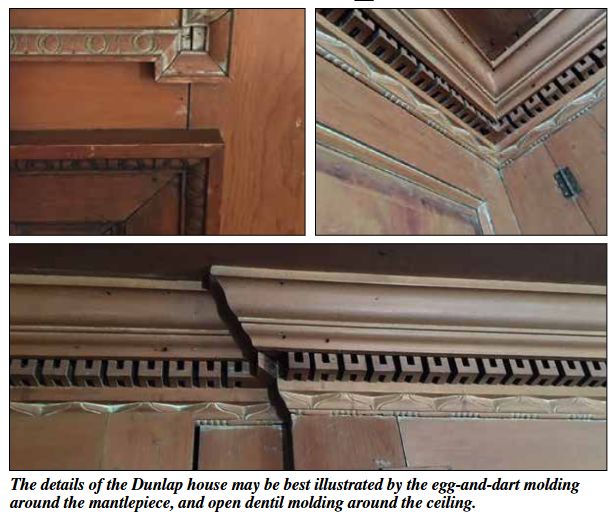
In 1797, five years after the death of his brother, John, Samuel and his family moved to Salisbury and bought an existing home with a mill. While Samuel lived there, it is believed, due to the distinctive carving style that exists, that he is the one who decorated his parlor with crossettes as well as egg-and-dart molding around the mantlepiece, and open dentil molding around the ceiling.
In 1926 Frank Trumbull, a former school teacher and owner of a sporting clothes store in Concord, MA bought the Salisbury home and had it moved to land he owned on Hooper Hill Road. He had it dismantled, with each piece numbered and stored over the winter in a barn. In 1927 the foundation was laid, and the house was reassembled. Only one three-inch piece of molding was missing.
The house originally consisted of a kitchen area with a large fireplace, a borning room, a parlor, and a bedroom. There was an upstairs, but it was not built out. The home is made of wooden clapboards. The Trumbulls used the house as a weekend and vacation home and therefore did not make many changes.
Eventually it was sold to Ed and Rheba Locke in 1947, who lived there, also without making many changes, until 1969, when it was bought by the Palmers. In the ensuing years, the house has been well maintained and left substantially unchanged, but an addition has been added. Interestingly, the structure for the addition was also brought from Salisbury. In 2004 it was dismantled, numbered, and reassembled with the same successful outcome.
This rare and precious bit of history remains preserved high on the hill adding to New Boston's story.
Editor's note: this was Mary Atai's first history column in the Beacon. Mary began her long-running "Behind the Door" series the following year.
Click here to return to the main page for "Behind the Door" articles.